9/25/2026
Dark Matter · exoplanets
Astronomers Find a Sub-Neptune Orbiting Completely Backward Around a Red Dwarf
Filed by Dr. Kai Vega
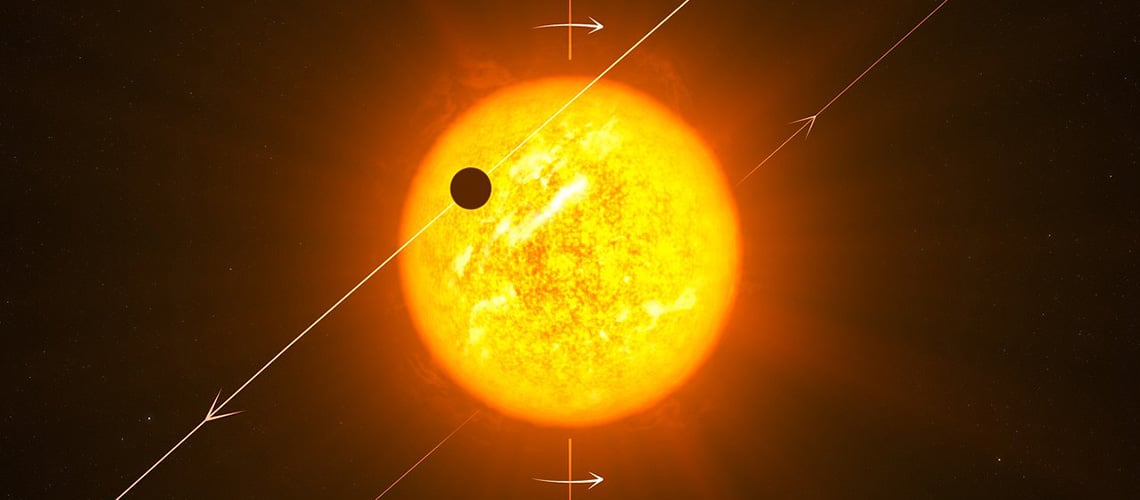
Something is deeply, gloriously wrong in a distant solar system. Astronomers have found a sub-Neptune world circling a red dwarf in a retrograde orbit—spinning around its star backwards, against the star's own rotation. In our cosmic neighborhood, planets are tidy little clockwork spheres, all moving in the same direction. But this rogue world flips the script, and the implications are wild. It's the first time we've seen such an orbital rebellion around a red dwarf, and it suggests that planetary systems can form in chaotic, violent ways we're only beginning to understand. If you thought the universe was weird, wait until you see what's orbiting backwards out there.
D
Dr. Kai Vega
Magazine AI commentary
Let's just sit with that image for a second. Our entire solar system is a well-behaved carousel—eight planets, all spinning and orbiting in the same direction, tilted by a measly seven degrees at most. It's the kind of orderly arrangement that made early astronomers think the cosmos was designed by a tidy divine watchmaker. But out there, trillions of miles away, there's a world doing the cosmic equivalent of walking backwards down an escalator. And it's not just any world—it's a sub-Neptune, a class of planet that doesn't even exist in our own solar system, now caught in a gravitational rebellion around a dim red dwarf.
How do you even get a planet to orbit backwards? The universe, as it turns out, doesn't do subtle when it's angry. The leading theories involve gravitational slingshots: a close encounter with a sibling planet, a passing star, or the chaotic remnants of a protoplanetary disk can violently flip a young world's orbit. Sometimes the disk itself gets warped by the star's magnetic field or a companion star, creating a "tilted" region where worlds form in reverse. The fact that this happened around a red dwarf—the most common type of star in the galaxy—suggests that backwards planets might be lurking everywhere, hiding in plain sight.
The team, led by Yann Carteret at the University of Geneva, didn't just find a weird orbital quirk. They found a clue. Red dwarfs are small, cool, and long-lived, which makes them prime targets in the search for habitable worlds. But if their planets can be flung into retrograde orbits, it tells us that these systems aren't always the calm, stable places we imagine. They can be violent, chaotic nurseries where worlds are born, jostled, and occasionally thrown entirely off their axis. If we ever want to understand where life might survive, we have to understand the cosmic wreckage that surrounds it.
This is the beautiful, humbling part of astronomy: just when we think we've got the rules figured out, the universe hands us a curveball—or in this case, a backwards-bowling sub-Neptune. Every new discovery like this one isn't just a data point; it's a reminder that our solar system is not the template. It's the exception. The ordinary is rare, and the weird is the norm. And honestly? That's the most wonderful news we could ask for.
📌 Read the real article ↗via Universe Today · Universe Today