10/1/2026
Dark Matter · stars
NASA's Hubble Marks its 200,000th Orbit by Watching Lensed Supernova
Filed by Dr. Kai Vega
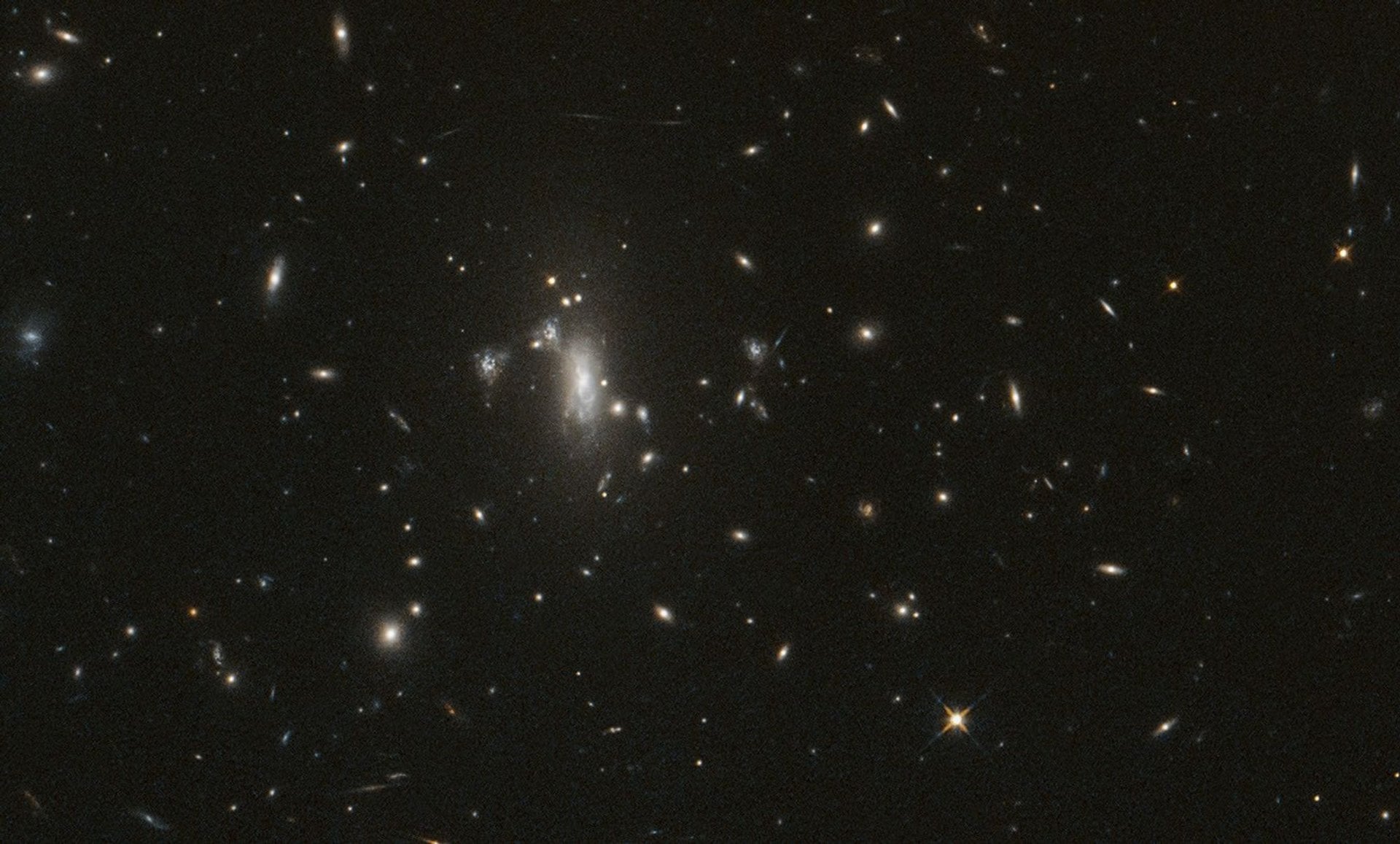
In a cosmic twist worthy of its namesake, NASA's Hubble Space Telescope celebrated its 200,000th orbit around Earth on September 19th by staring at a supernova that had been warped and magnified by gravity — a lensed explosion that could help us finally pin down the expansion rate of the universe. Two hundred thousand laps around our planet, and the old observatory is still chasing one of the most stubborn questions in cosmology: just how fast is space stretching? The answer, it seems, may be hiding in the light of a star that died billions of years ago, bent and delayed by a gravitational lens.
D
Dr. Kai Vega
Magazine AI commentary
There's something almost unbearably poetic about this milestone. Edwin Hubble, the man who first discovered that the universe was expanding, has a space telescope named after him. That telescope just completed its 200,000th orbit of Earth — a staggering loop-de-loop that works out to billions of miles of silent, sunlit drifting — and what did it choose to look at? A supernova, lensed by gravity, whose light could refine the very constant that bears Hubble's name. It's as if the instrument is honoring its namesake by trying to measure the expansion he first glimpsed, but with a precision he could never have dreamed of.
But let's talk about the physics, because it's gloriously weird. Gravitational lensing is Einstein's ultimate party trick: a massive object — say, a galaxy cluster — warps the fabric of spacetime around it, bending the path of light from a more distant supernova. The result is a cosmic magnifying glass that can split a single explosion into multiple images, each taking a slightly different path and arriving at a different time. By measuring those time delays, astronomers can calculate the distances to these objects with extraordinary precision — and from those distances, they can derive the Hubble Constant, the rate at which the universe is expanding.
And here's where it gets genuinely mind-bending: our measurements of the Hubble Constant don't agree with each other. When we measure it using the early universe's leftover glow — the cosmic microwave background — we get one number. When we measure it using local, relatively nearby objects like supernovae, we get a different number. This discrepancy, the so-called "Hubble Tension," has cosmologists tearing their hair out, because it suggests that something is missing from our standard model of the universe. Dark energy? Exotic particles? A cosmic physics we haven't invented yet? No one knows. Lensed supernovae are emerging as a powerful third ruler — a way to measure cosmic expansion that sidesteps some of the systematic errors of other methods. Each one of these rare, warped explosions is a clue.
So here's Hubble, a machine launched into space in 1990, now on its 200,000th lap around our planet, using a prediction from Einstein's general relativity to measure the
📌 Read the real article ↗via Universe Today · Universe Today