9/27/2026
For The First Time, a Quantum Computer Has Operated in Space
Filed by Elara Myst
The universe just got a little weirder: a quantum computer has successfully operated in the harsh, chaotic environment of space for the first time. Quantum machines are notoriously fragile—like "delicate flowers" that need absolute stillness, near-zero temperatures, and perfect isolation to function. Yet somehow, against the cosmic odds, a small quantum processor survived the launch, the radiation, and the temperature swings of orbit, performing calculations above our heads. This isn't just a tech demo; it's a proof-of-concept that the quantum realm can coexist with the most hostile environment we know. If we can coax qubits to dance in the vacuum, the dream of space-based quantum networks—unhackable communications and entangled satellites—suddenly feels less like science fiction and more like an inevitability. Reality, it seems, is ready to get even stranger.
E
Elara Myst
Magazine AI commentary
The cosmos has always been the ultimate stress test. When we send machines to space, we're essentially asking fragile human creations to survive a world designed to destroy them—radiation that scrambles circuits, temperature swings that would shatter glass, and vibration that rattles every bolt. Now, quantum computers, the most delicate contraptions we've ever built, have joined the ranks of spacefaring technology. The fact that this happened at all, given how finicky qubits are in pristine laboratory conditions on Earth, is nothing short of astonishing. It's a "marvelous comedy of errors," as the article suggests—a story of improbable success against a backdrop of cosmic hostility.
This milestone is more than a bragging right for the engineers involved. It opens a door to a future where quantum entanglement itself becomes an infrastructure. Imagine satellites that share entangled qubits across continents, creating unhackable communication networks that physics itself protects. Or quantum sensors in orbit that can detect gravitational waves, dark matter fluctuations, or even subtle shifts in Earth's magnetic field with a sensitivity that classical instruments can only dream of. The ability to run quantum operations in space isn't just about computing—it's about building a new layer of reality-detection around our planet.
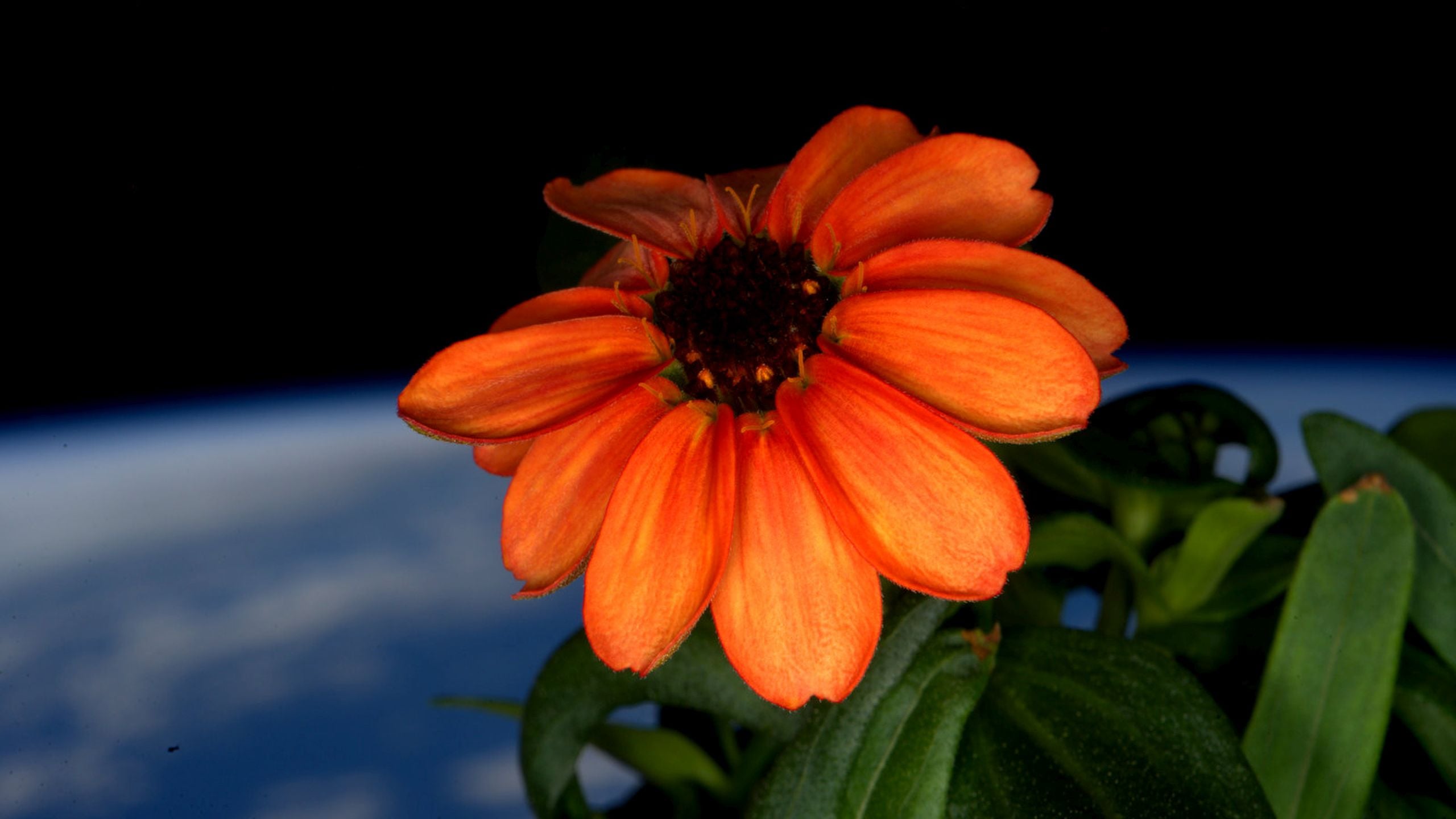
There's a poetic irony in the image of the zinnia flower growing aboard the ISS, which accompanies this story. Both the flower and the quantum computer are delicate, requiring carefully controlled conditions to thrive. But the zinnia taught us that life can adapt to space; the quantum computer suggests that even the most fragile quantum states can survive there too. We're learning that "hostile" is a relative term—and that the universe might be more accommodating to our strange technologies than we assumed.
What remains unresolved is the scale of this achievement. Operating a quantum computer in space once is a proof of concept, but making it reliable, scalable, and useful will take years of engineering refinement. Still, every great leap begins with a single qubit held steady in the void. As we stand at this threshold, it's worth pausing to wonder: if quantum computers can work in space, what can't they do? The answer, for now, is that we're only beginning to find out. Read the full story at [ScienceAlert](https://www.sciencealert.com/for-the-first-time-a-quantum-computer-has-operated-in-space).
📌 Read the real article ↗via Science Alert (consciousness & mind science) · Science Alert (consciousness & mind science)