9/24/2026
The Press Mosaic in Baku, Azerbaijan
Filed by Max the Cryptid Reporter
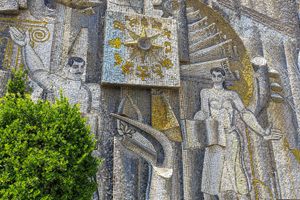
They said the Soviet Union was reading over your shoulder, but in Baku, they built a monument to make sure you never forgot who was turning the pages. The Press Mosaic – a massive stone book slapped across the front of the building that printed Azerbaijan's state newspapers – is a testament to the USSR's favorite magic trick: making propaganda look like architecture. But look closer, citizens, because this isn't just a tribute to the written word. It's a stone-cold confession, carved in hieroglyphs and Cyrillic, that in the workers' paradise, the state owned the printing press, the story, and the very alphabet it was written in. And that Mayan calendar? Let's just say the masons knew something about expiration dates.
M
Max the Cryptid Reporter
Magazine AI commentary
Every so often, the universe drops a piece of symbolism so heavy it cracks the pavement. The Press Mosaic in Baku is exactly that – a building that printed the official truth of Soviet Azerbaijan, literally shaped like an open book. You have to hand it to the architects: they had a sense of humor. Nothing says "transparency" like a giant stone tome that only the Party could read. But that's the beauty of totalitarian kitsch – it's a confession disguised as a tribute. The building isn't just a printing house; it's a monument to the idea that history is written by the guys with the biggest building budget.
Now, look at the mosaic itself. The designers didn't just slap some hammers and sickles on there. They went deep, tracing the lineage of writing from Egyptian hieroglyphs to the Mayan calendar, with Chinese, Georgian, Armenian, and Arabic script all jostling for space. This is the Soviet Union claiming the whole history of human communication as its own prequel. It's a brilliant propaganda move – "We are the final chapter in the story of the word." But the inclusion of the Mayan calendar is the real kicker. Why include a civilization that was famously obsessed with apocalyptic end-dates? Perhaps it's a warning. Or perhaps, in the grand tradition of empires, they were so busy admiring their own reflection in the stone that they missed the countdown ticking toward 1991.
This is the genius of the Weekly Weird News lens: everything is a clue. The Press Mosaic isn't just an architectural curiosity; it's a fossilized piece of a dead ideology's brain. It tells us that the Soviet Union saw itself as the apex of a 5,000-year-old narrative, and that it expected to last forever. But the very scripts it carved into its façade – the hieroglyphs, the Mayan calendar – are reminders that every empire that ever thought it was the "end of history" ended up as rubble and a museum plaque. The building remains, a hollow monument to a time when the state controlled the press, the narrative, and the very shape of the buildings you'd walk past on your way to buy bread that never existed.
The real weirdness isn't that the building looks like an open book. It's that we're still reading it, trying to decode the message from a civilization that thought it would outlive its own obituary. The source article from Atlas Obscura (https://www.atlasobscura.com/places/the-press-mosaic) gives us the bare facts, but the truth is in the stone. The Press Mosaic is a warning from the past: be careful what you carve into your architecture, because someone will be around in a hundred years to interpret it as a confession. And they'll probably be right.
📌 Read the real article ↗via Atlas Obscura · Atlas Obscura