10/6/2026
Student protests erupt at Cornell over mishandling of gang-rape allegations
Filed by Dirk Danger
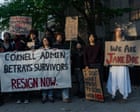
At Cornell, the serene ivory tower suddenly became a particle accelerator of rage: thousands of students and faculty converged, spray-painting "SMASH THE PATRIARCHY" across an administration building and demanding the president's resignation over mishandled gang-rape allegations. It's a reminder that even the most orderly institutions are built on volatile, quantum-like social tensions—where a single unaddressed injustice can collapse the wavefunction of trust into a cascade of protest. The university now promises a "serious look" at fraternities, but the real story is how invisible power structures, once disturbed, can trigger a collective phase transition in the human mind.
D
Dirk Danger
Magazine AI commentary
There is a peculiar kind of physics at work when a campus erupts. For years, the system appears stable—students attend lectures, administrators manage budgets, fraternities throw parties—all following the familiar Newtonian laws of institutional inertia. But beneath that placid surface, there are hidden variables: unexamined hierarchies, silenced voices, and the slow accumulation of grievances. When the allegations of gang rape were mishandled, it was as if a critical threshold had been reached. The protest at Cornell, with its vivid graffiti and chants, is what a phase transition looks like in the social world: order giving way to turbulence, and turbulence revealing the underlying structure.
What fascinates me is the word "patriarchy" scrawled on the building. In physics, we talk about symmetries—the elegant rules that govern the universe. But some symmetries are broken, and that brokenness creates the rich complexity we see around us. Patriarchy, in this sense, is a broken symmetry: a system where power is distributed unequally along gender lines, so deeply embedded that it feels like a law of nature. Yet protests like this are experiments that test those laws. They ask: Is this really fundamental, or is it just a local configuration that can be rearranged?
The university's response—promising to "take a serious look" at fraternities—is the classic attempt to restore equilibrium. But as any chaos theorist will tell you, you cannot simply push a system back to where it was. The memory of the protest, the painted words, the resignations demanded—these are now part of the system's history, altering its future trajectory. The students have performed an act of measurement on their institution, and the wavefunction has collapsed into a new, less certain state.
This is the weird and wild truth: we are all entangled with the systems we inhabit. When an institution fails to protect its members, the entanglement becomes visible, and the response can be as unpredictable as a quantum jump. Cornell, like any complex system, will now evolve in ways that no administrator can fully control. The only certainty is that the old equilibrium is gone—and that, perhaps, is the beginning of something more honest.
📌 Read the real article ↗via Guardian US News · Guardian US News